
The Epley maneuver doctors recommend, on big-print cards by your bed. A calm voice counts the seconds for you.


You grab the sheet. You're afraid to move, afraid to sit up, afraid it's something worse. It stops in under a minute, but it feels like forever. And then you lie awake, scared it will happen again the moment you turn your head.

Deep in your inner ear, tiny calcium crystals can slip into one of the balance canals. When you move your head, they roll, and your brain thinks the whole world is turning. It's called BPPV, and it's the most common cause of this kind of spinning.
The good news: a simple series of head positions, the Epley maneuver, guides the crystals back where they belong. It's the first treatment U.S. ear, nose and throat doctors recommend, and it works for about 8 in 10 people, sometimes after a few tries.
Source: American Academy of Otolaryngology, clinical practice guideline and patient FAQ on BPPV.

Your eyes want to close. You can't pause it, you lose the step, and nobody counts the seconds for you.
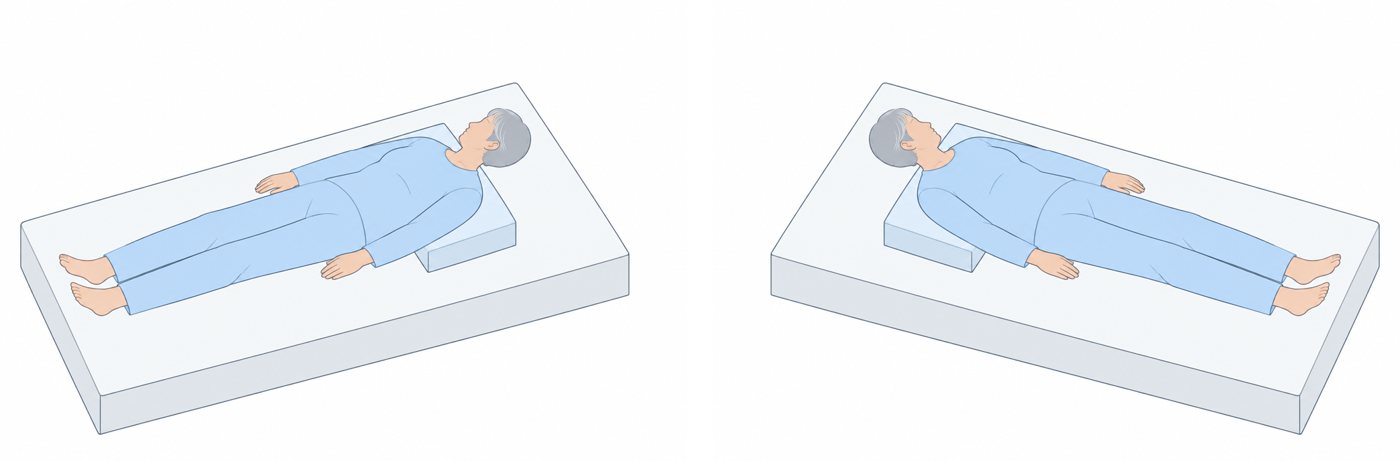
Right ear and left ear are mirror images. Most videos show only one. If yours is the other, you can do everything right and still feel no better.

A single visit can cost around $150, and it happens at night, when no office is open.
Everything you need to do the maneuver at home, calmly and on the right side. Made for real people, in big print, with no technology to figure out in the middle of the night.
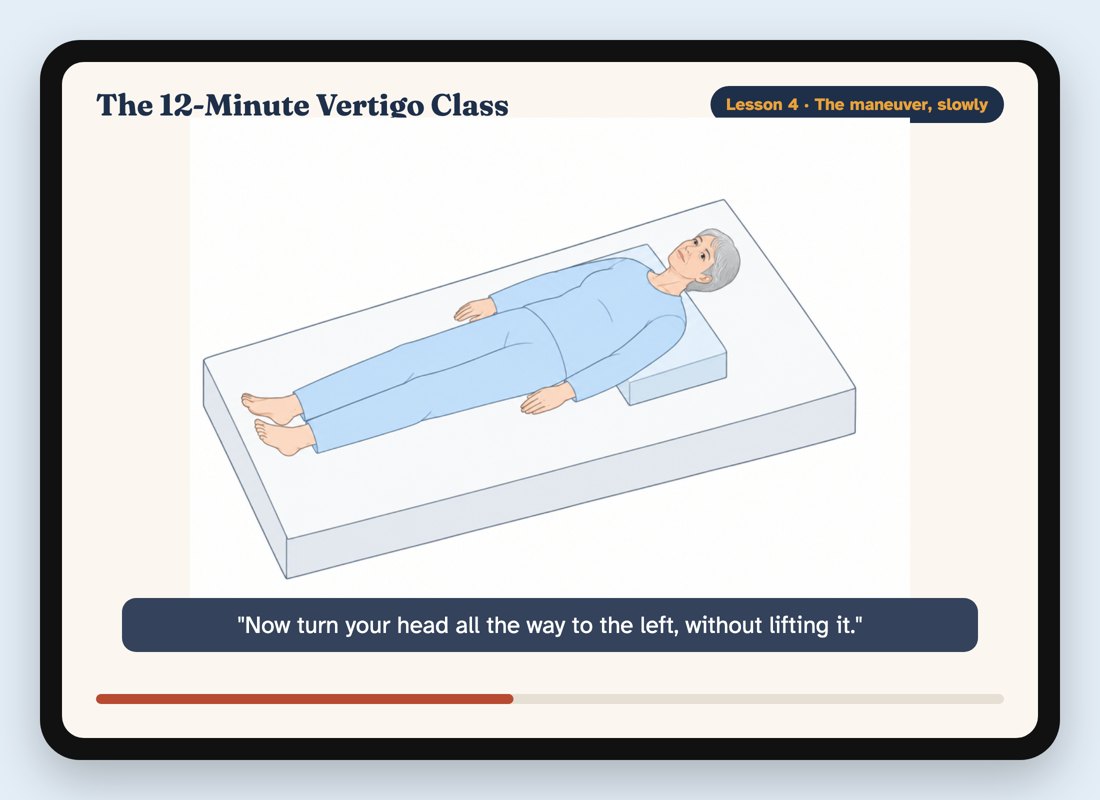
A short video lesson to watch today, not during an attack. See why the room spins, how the side test works and each position, slowly. Watch it with the person who'll help you.

A simple test you do sitting on your bed. It tells you which ear is involved, so you do the right version. Not sure? The guide tells you exactly who to see instead of guessing.

Your side, on one big-print card you keep by your bed, with every position drawn. Scan the code on the card and a calm voice tells you when to move and counts the seconds for you. No screen to watch, nothing to count.

What's normal in the days after, how long the unsteady feeling can last, how to sleep without fear, and when to see a professional. And because it can come back, the 3 A.M. Card stays by your bed, ready.

This is exactly what you get: every page designed to be read with tired eyes, in a dark room, in a hurry.
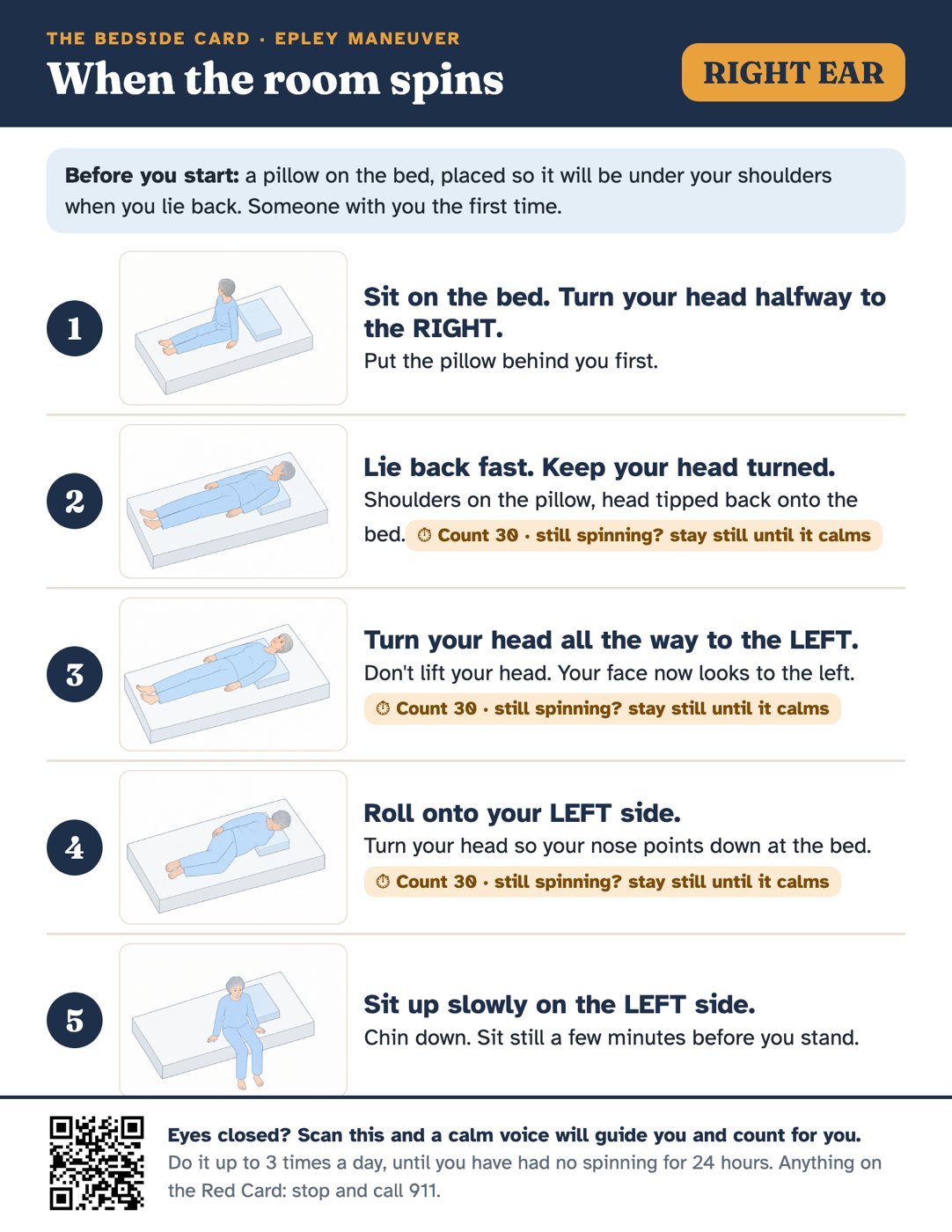
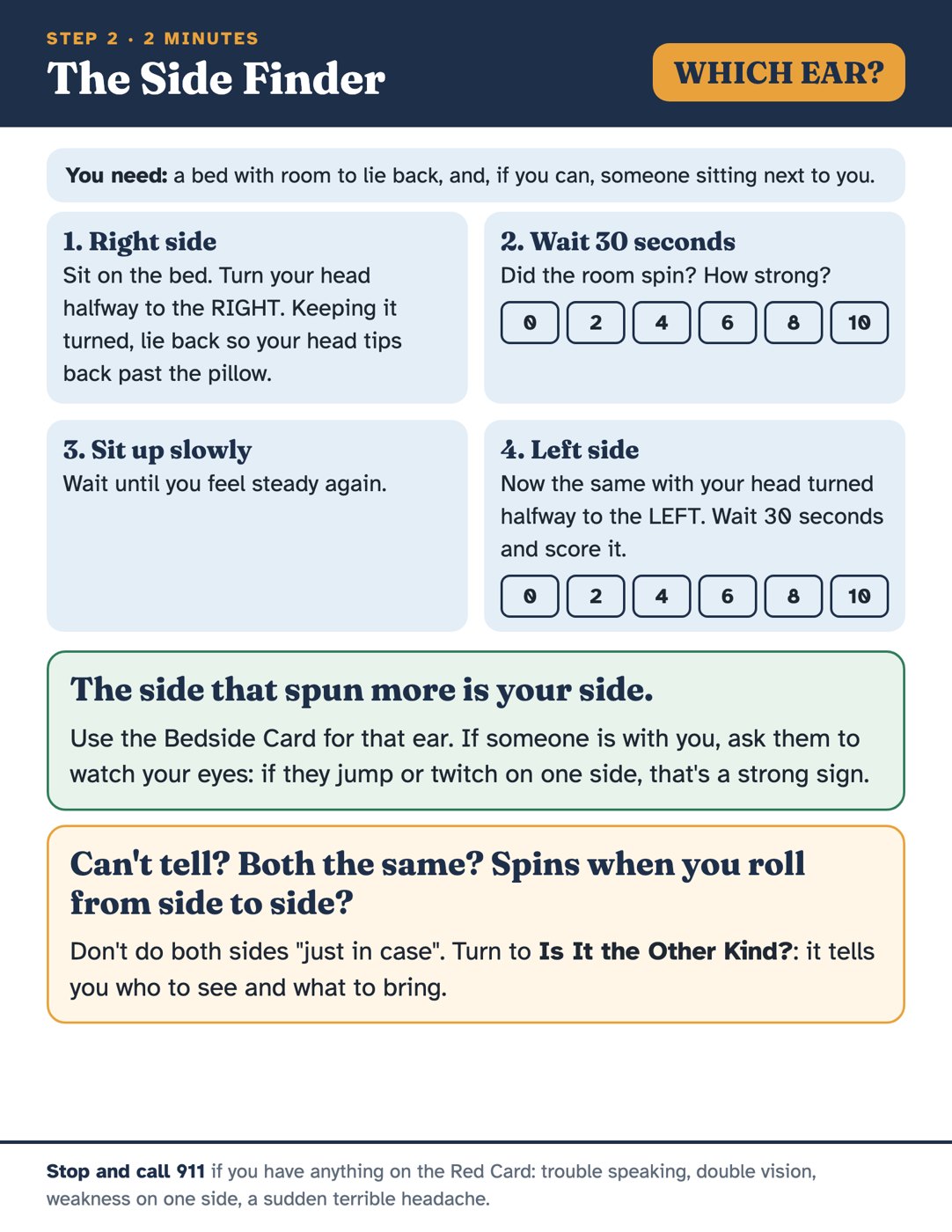
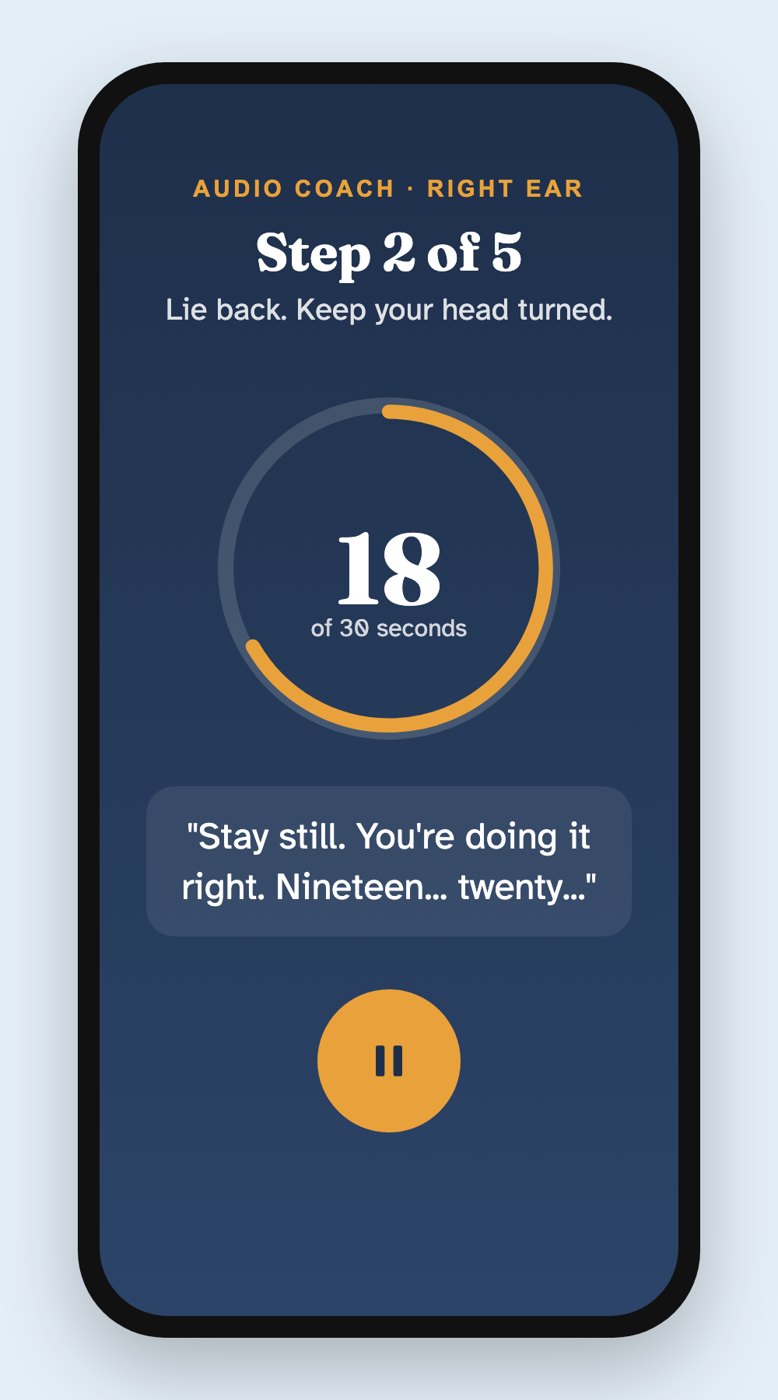
Swipe to see more pages →

Total value $244 · Regular price $97
One-time payment. No subscription. Digital download, sent to your email right away.

Michael P. is a licensed physical therapist in the United States. Week after week he sees the same story: someone wakes up with the room spinning, waits weeks for an appointment, tries a YouTube video on the wrong side, and ends up too scared to try again.
"When I do the maneuver in the clinic it takes a few minutes. What people are missing at home is someone telling them which side, which position, and how long to hold it, right when they need it."
So we built exactly that, together with him. Every card and every word of the audio goes past Michael before it reaches you.

The Helper's Page tells a daughter, a husband or a friend exactly what to do: how to support the head, when to read each step, and how to keep her safe when she sits back up. Send the kit to your own email, print the cards, and keep a set at her bedside.
Get it for someone you loveLock in the $37 launch priceWho should not do this alone (neck or back problems, heart problems, a recent stroke, a detached retina) and why the first time should never be alone.
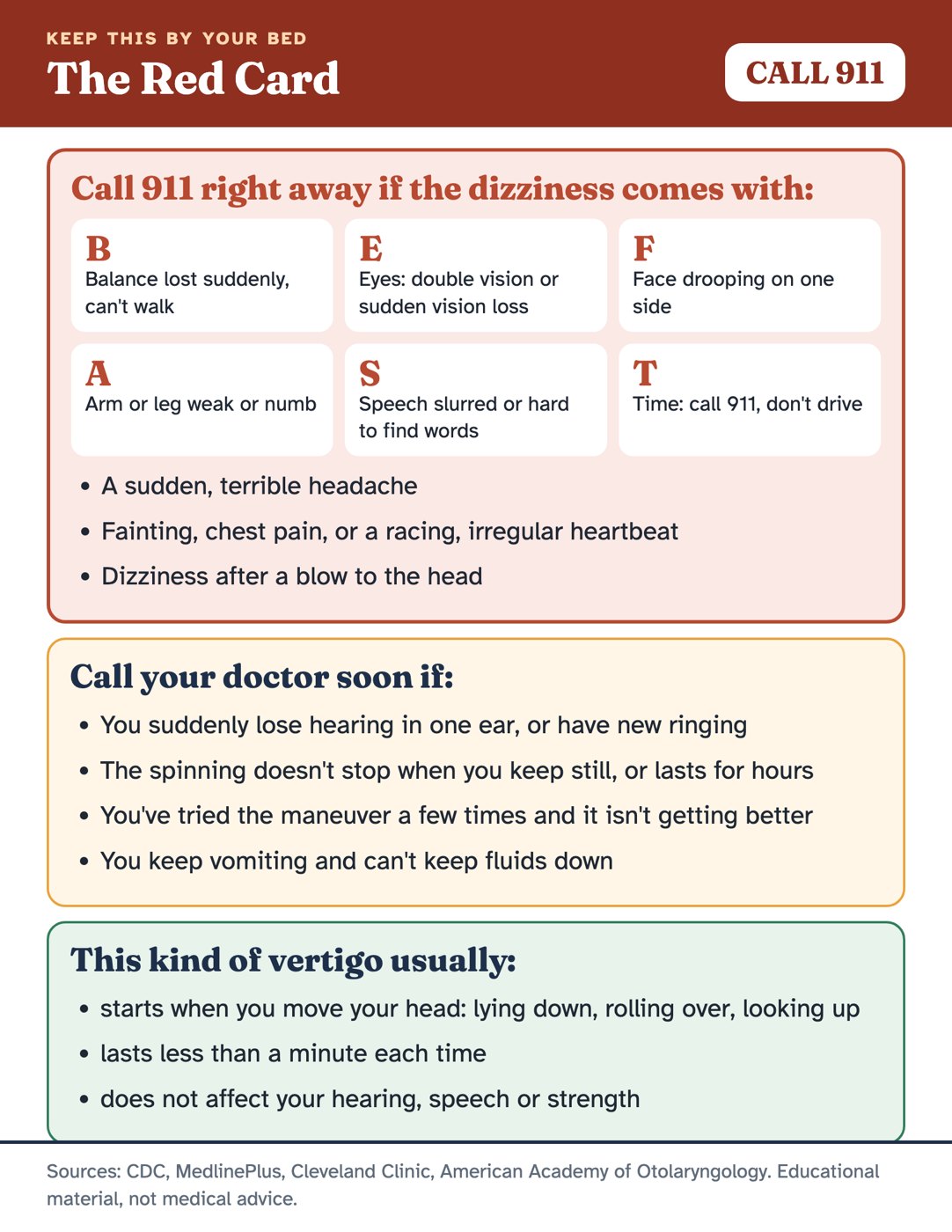
The warning signs that this is not positional vertigo, like trouble speaking, double vision or weakness on one side, and when to call 911 right away.
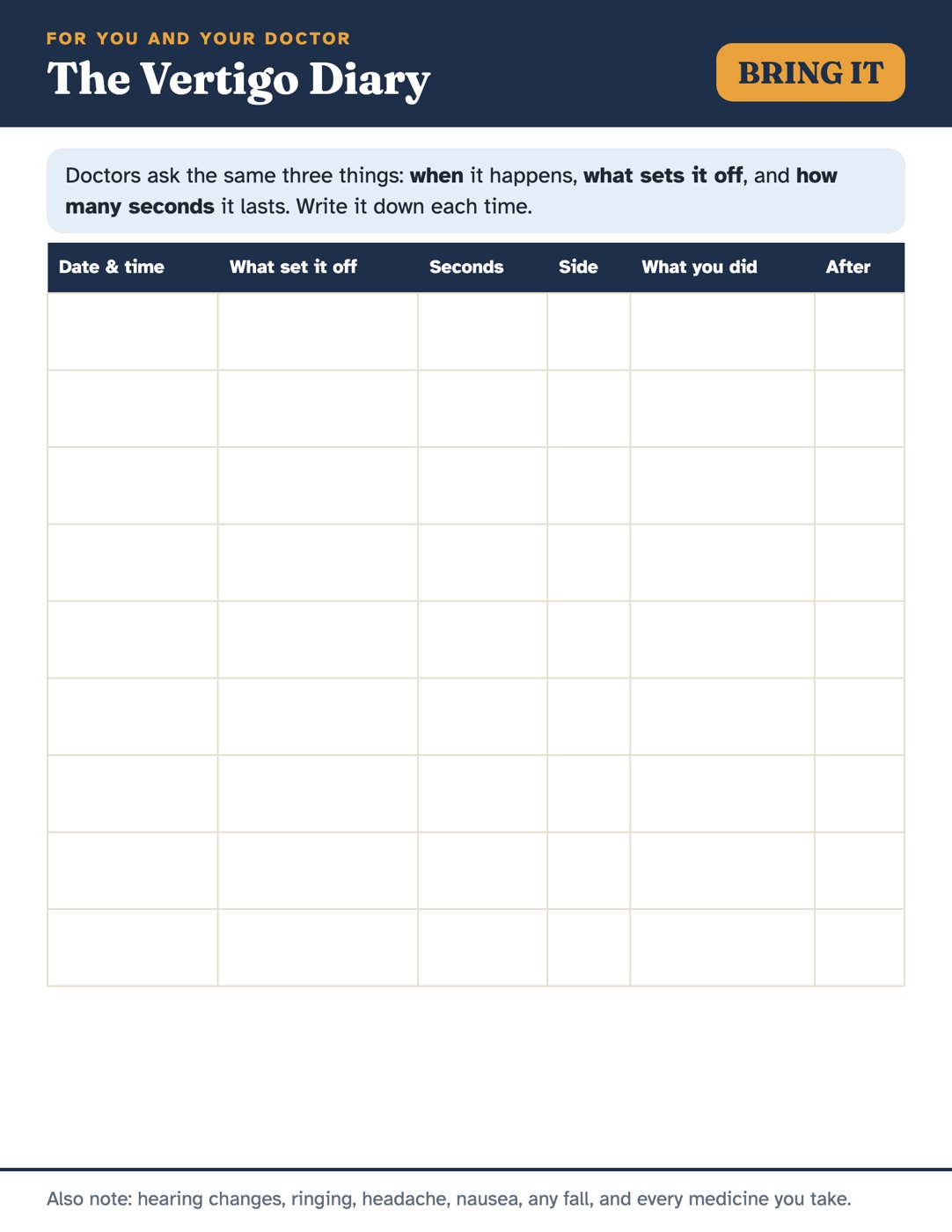
If it spins when you roll from side to side, it may be a type you can't sort out alone. We tell you who to see, and what to bring.
Keep the cards by your bed, watch the lesson, use the audio. If after 30 days it isn't for you, write to us any time between day 30 and day 60 and we'll refund you in full. No forms, no questions.
No. Everything works on a phone or tablet. But we recommend printing the Bedside Cards, at home or at any print shop, so they're by your bed when you need them. They're big print on purpose.
For most people with positional vertigo, yes, and the Epley maneuver is widely taught for home use. But not for everyone: Before You Start lists who should not do it alone, and the Red Card tells you when to call 911. The first time, have someone with you.
The 2-Minute Side Finder walks you through a simple test on your bed. If you can't tell, the guide doesn't tell you to "just do both sides". It tells you who to see instead.
No product can honestly promise that. What this does is show you, step by step, the maneuver U.S. ear doctors recommend for positional vertigo, and tell you clearly when it's time to see a professional instead.
It often does, and that's exactly why the kit stays by your bed. The 3 A.M. Card tells you what to do the next time, without starting from zero.
That's who we made it for. You get one email with one link. Print the cards, and the audio opens by pointing your phone camera at the code on the card.
Of course. Use your own email at checkout, print the cards for her, and read the Helper's Page together.
Right after checkout you receive an email with your personal link: cards, audio, video lesson and every bonus. Nothing is shipped.
The right side, the right positions, and a calm voice counting for you.
Total value $244
Ends in 08:00:00
Get the Bedside Vertigo SystemLock in the $37 launch priceLeave your email and we'll send you the Bedside Vertigo System at the $37 launch price the day it opens.